Pet Stain Carpet Gold Coast, and Whether It Will Come Out
Some pet marks lift completely. Some lighten and stay. The difference is decided long before we turn up, and a pet stain carpet job on the Gold Coast is one of the few where we would rather tell you the honest answer than the hopeful one.
✔ Family & pet safe treatments✔ Licensed & insured✔ IICRC accredited✔ Since 2011
What Gold Coast locals say on Google 5.0 stars from 396 Google reviews
"Phil is not only a great guy, but he genuinely knows how to solve any problem you throw at him, and we've certainly had a few over the years."
Melanie B., Google review
★★★★★
"Phil is hands-down the best pest control guy we've ever had. He shows up right on time, always friendly and professional, and took the time to actually explain what he was doing and why."
Tanya G., Google review
★★★★★
"Had an amazing experience. They were very quick and efficient, I couldn't have asked for anything more. Phil and his team did an amazing job and couldn't recommend more."
Jorja W., Google review
★★★★★
"Gave me honest and genuine advice and service at a great price."
Google review
★★★★★
"Extremely high standard of work, communication and customer service."
Google review
★★★★★
"Phil and Cooper did a fantastic job cleaning our carpet, rugs and furniture."
Google review
Short answer: it depends on whether you are looking at soiling or at staining, and they are not the same thing. Soiling sits in the fibre and comes out. Staining is dye that has already changed the colour of the fibre, and no amount of cleaning puts that colour back. Four things decide which one you have: how long it sat, how far down it went, what the carpet is made of, and what has already been put on it.
Written by Phil, CPH Services Gold Coast. Carpet cleaning technician and licensed pest control technician, working Gold Coast properties since 2011. IICRC accredited. Three Best Rated Best Business, 2016 to 2026.
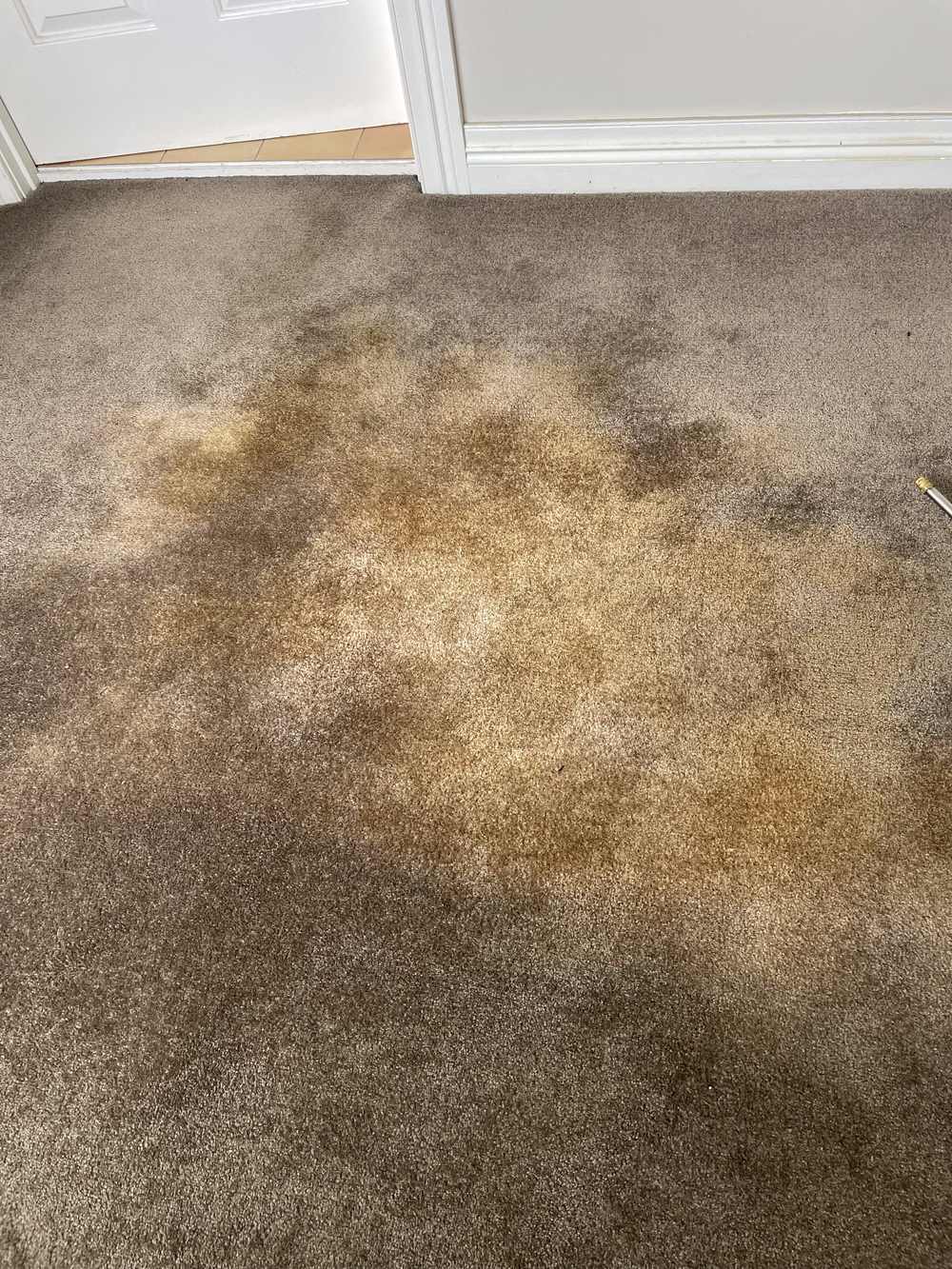
What the photo actually shows
That is not one accident. It is the same spot used over and over, spreading out from the doorway into the room, and it has been there long enough to go brown at the centre and yellow at the edges.
A patch like this is the honest version of the question. Some of what you can see will lift. Some of it has already changed the carpet.
We see a patch like this almost every day, and the phone calls about it all sound much the same. On this one we put antimicrobial enzyme treatment through it, but visually it was not going to look any better. The bacteria had worked down into the underlay, and set stains like these are permanent.
New carpet would not fix it either, because the cause is the habit, not the carpet. If the pets live indoors, the honest advice is to train them to go outside, or to one spot set up for it inside. Accidents happen, and that is a different thing. This is what it looks like when the same spot gets used day after day, and some fibres show it far more than others.
Soiling comes out. Staining does not
This is the whole answer, and it is worth understanding before anyone gives you an estimate.
Soiling is material sitting in and around the fibre. It responds to treatment and extraction, and when it goes, the carpet returns to an even colour.
Staining is different. Urine carries dye, and once that dye has bonded to the fibre it has changed the colour of the carpet itself. Cleaning removes what is sitting on the fibre. It cannot put colour back into a fibre that has been dyed a different shade.
Most real pet patches are both. That is why one lifts most of the way and then stops, and why an honest operator talks about improvement rather than removal.
The four things that decide it
How long it sat. This matters more than anything else. Damp and fresh is the best case. Once it dries, the dye has time to bond, and it keeps getting harder from there.
How far down it went. A surface mark is one job. Something that has run through the backing into the underlay is another, because the source is now under the part you can see.
What the carpet is made of. Wool takes dye readily, which is exactly why it stains readily. Solution dyed synthetics hold their own colour much better. The same accident on two carpets gives two different results.
What has already been put on it. Some household products and supermarket sprays lighten the fibre or fix the stain in place. We would rather know than guess.
Got questions? Straight answers below. Or skip ahead:
A pet accident is acidic. Heat sets an acidic stain into the fibre instead of releasing it, so the instinct to attack it with the hottest water available is the one instinct to ignore.
Scrubbing is the other one. It spreads the source sideways into clean carpet and drives it further down towards the backing, which turns a small problem into a large one.
What we use is an antibacterial enzyme treatment as standard, and an antimicrobial enzyme treatment where the soiling is heavier and more established. The enzymes break the source down rather than covering it.
The mark and the smell are two different jobs
People are often surprised that the patch looks better and the room still smells. That is not a failure, it is the geometry of the problem.
What you see is on top. What you smell has usually gone down through the backing into the underlay, and in the worst cases into the floor underneath. Lifting the colour does nothing to the part that is under it.
The honest position, which we will give you on the day: odour treatment reaches a long way, and it does not make a carpet new. If the toileting has not stopped, it comes back, and that is a conversation about the animal rather than about the carpet.
What we do before we start
We look at the patch, feel how far down it goes, check the fibre, and ask what has already been tried. Then we tell you what we expect, in plain terms, including the parts we do not expect to shift.
Sometimes the honest answer is that the carpet is at the end of its life in that area and a clean buys time rather than fixing it. We would rather say that than take the job and disappoint you.
It follows the size of the affected area, how deep it has gone, and whether the job is a clean, an odour treatment, or both. A single fresh spot is a different job to a doorway that has been used for a year.
The minimum call-out fee is $145 plus GST, the same across the Gold Coast to Tweed Heads area. You get an estimate rather than a quote, because the fibre and the depth are things we confirm in front of the carpet.
Pet accident on the carpet and not sure what you are looking at? Call 1300 85 48 28. We will tell you honestly what we think will lift and what will not, before you book anything.
Frequently asked questions
Will a pet stain come out of carpet completely?
Sometimes. If it is soiling sitting in the fibre it usually lifts and the carpet goes back to an even colour. If the dye in the urine has already changed the fibre colour, that part is permanent and cleaning will not bring it back. We tell you which one we think you have before we start.
What is the difference between soiling and staining?
Soiling is material sitting on and around the fibre. It is removable. Staining is a colour change in the fibre itself. It is not. The same accident can leave both, which is why a patch often lifts a long way and then stops.
Does it matter how long the stain has been there?
Yes, more than anything else. A fresh accident that is still damp has the best chance. Once it has dried, the dye has had time to bond to the fibre, and every week after that makes it harder.
Can cleaning make a pet stain worse?
The wrong approach can. Hot water sets an acidic stain rather than lifting it, and scrubbing spreads the source sideways and pushes it deeper. We use an antibacterial enzyme treatment as standard, and an antimicrobial enzyme treatment for heavier, more established soiling.
What if I have already tried something on it?
Tell us what it was. Some household products and supermarket sprays bleach or set the fibre, and a patch that has been treated at home is a different job to an untreated one. We are not going to tell you off, we just need to know what we are working with.
Why does the smell come back when the mark has gone?
Because the mark and the source are in different places. Urine runs down through the backing and into the underlay, so you can lift the surface colour and still have the source underneath. That is treated separately, and the honest position is that it returns if the toileting does not stop.
What does a pet stain carpet job cost on the Gold Coast?
It follows the size of the affected area, how far down it has gone, and whether odour treatment is needed as well as the clean. The minimum call-out fee is $145 plus GST. You get an estimate before anything is booked.
Ready for an honest estimate?
Tell us about the job. Phil replies personally between jobs, usually within 2 to 4 hours. Urgent? Call 1300 85 48 28. No pressure, no lock-in, no call centre.