What Pest Control Gold Coast Technicians Look For in the Roof Void
Does a pest treatment include the roof? Where the void is safely accessible, yes, and it is often the part of the house that answers the question. Pest control Gold Coast properties need is decided as much by what is above the ceiling as what is walking across the floor.
✔ Family & pet safe treatments✔ Licensed & insured✔ IICRC accredited✔ Since 2011
What Gold Coast locals say on Google 5.0 stars from 396 Google reviews
"Phil is not only a great guy, but he genuinely knows how to solve any problem you throw at him, and we've certainly had a few over the years."
Melanie B., Google review
★★★★★
"Phil is hands-down the best pest control guy we've ever had. He shows up right on time, always friendly and professional, and took the time to actually explain what he was doing and why."
Tanya G., Google review
★★★★★
"Had an amazing experience. They were very quick and efficient, I couldn't have asked for anything more. Phil and his team did an amazing job and couldn't recommend more."
Jorja W., Google review
★★★★★
"Gave me honest and genuine advice and service at a great price."
Google review
★★★★★
"Extremely high standard of work, communication and customer service."
Google review
★★★★★
"Phil and Cooper did a fantastic job cleaning our carpet, rugs and furniture."
Google review
Short answer: where a roof void is safely accessible it forms part of the internal work on a standard general pest control treatment, which covers cockroaches, ants and spiders. Rodent work in the roof is an add on, scoped and booked on top, never assumed. If the void cannot be safely entered, that gets said on the day and the external and eave work is done instead.
Written by Phil, CPH Services Gold Coast. Carpet cleaning technician and licensed pest control technician, working Gold Coast properties since 2011. IICRC accredited. Three Best Rated Best Business, 2016 to 2026.
What a pest control Gold Coast visit looks for up there
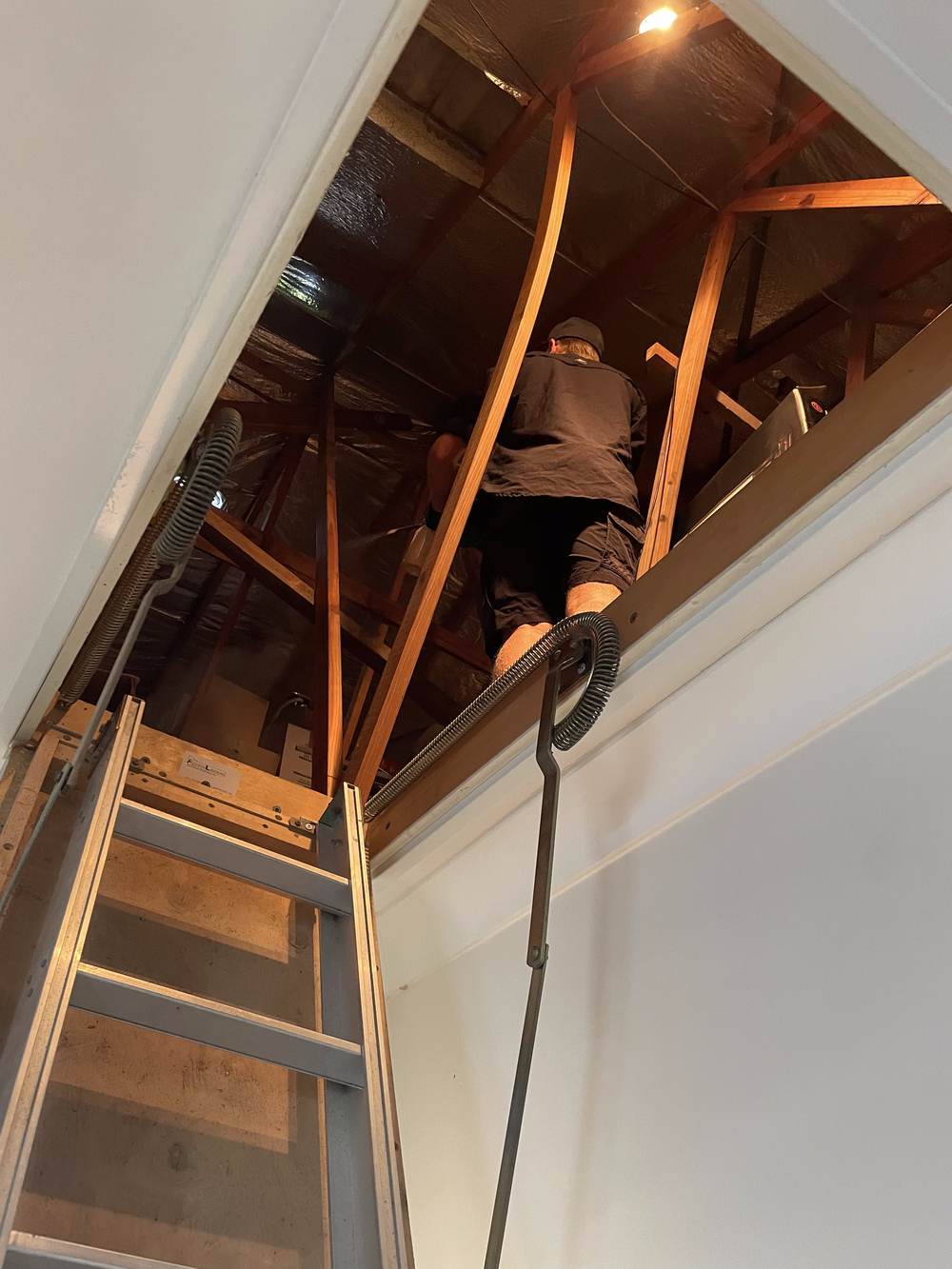
The job in this photo is a regular customer with an attic and a pull down ladder, which is about as easy as roof access gets. They asked for the attic area to be treated and a rodent station placed up there, so that is what was done, with the station booked as an add on.
The rules around entering roof voids have changed, and there are requirements that have to be met before anyone goes up. Safe, easy access like this is what makes that straightforward.
The manhole comes down, the ladder goes up, and someone goes in with a torch. That is the part of the job most people never see, because they are standing in the hallway underneath it.
A roof void tells you things the rest of the house will not. Cockroaches leave evidence in the insulation and along the timbers. Spiders build where the frame meets the roof sheeting. Rodents, when they are there, leave runs, droppings and rub marks along the joists that are obvious once you are looking at them and invisible from the floor below.
It also shows how they are getting in. Gaps at the eaves, a lifted tile, a torn vent, a gap where a pipe or a cable passes through. Those are the things that turn a treatment into a repeat visit if nobody finds them.
Is the roof void part of a standard treatment?
A standard general pest control treatment is cockroaches, ants and spiders. Where the roof void is safely accessible, it forms part of the internal work for those pests, because that is genuinely where a lot of the harbourage is.
What is not automatic is rodent work. Rodents, along with fleas, silverfish, wasps, midges, mosquitoes and vinegar flies, are add ons booked on top of the general treatment. They are things we do treat, they are simply not assumed. Turning up for a general pest job does not mean a rodent program gets installed in the roof.
So the roof void gets looked at, and what is found there decides the conversation. If the evidence is roaches and webbing, that is covered. If there are rodents up there, that is a separate scope, priced and agreed before anything goes in.
Why the roof matters more on the Gold Coast
Heat and humidity are the short version. A roof void here sits hot and it holds moisture through the wet season, which suits cockroaches and keeps the timbers and insulation attractive to anything looking for somewhere dark and undisturbed.
Vegetation is the other half. A branch touching the roofline is a bridge, and anything using that bridge skips the perimeter entirely. Trimming what touches the roof does more for a rodent problem than most things that come out of a bottle.
Stored boxes count too. A roof void full of cardboard is a roach habitat with a roof on it. Plastic tubs instead of cardboard is an unglamorous fix that genuinely works.
When the roof void does not get entered
Not every roof gets walked, and saying otherwise would be dishonest.
Some have no manhole. Some are too shallow to move through. Some have a ceiling that is not safe to work above, or insulation and wiring arranged in a way that makes it a bad idea. Low pitched roofs on older Gold Coast houses are the common case.
When that happens it gets said on the day, along with what is being done instead. The external perimeter, the eaves from a ladder, and treating the entry points that can be reached still cover a lot of ground. What does not happen is pretending an inspection took place that did not.
Warranty, report and cost
A treatment comes with a report, and what was found in the roof void goes in it, including anything that could not be reached and why.
On warranty: Australian cockroaches carry 6 months and ants carry 3 months. Webbing spiders carry a warranty, other spiders do not. For anything outside that standard scope, rodents included, warranties may apply depending on the circumstances at your particular property and on the infestation itself, assessed as needed for that property rather than promised in advance.
Cost follows the size of the property and what the job actually involves, with a minimum call-out fee of $145 plus GST. The pest control page sets out the standard treatment, and if the carpet is being done in the same visit the carpet cleaning page covers that side. Booking them together saves a second trip. If anything in the roof points to termites, that is a different trade with different licensing and it gets referred out to a termite specialist.
Common questions
Does a general pest treatment include the roof void?
Where the void is safely accessible, yes, as part of the internal work. A standard general pest control treatment covers cockroaches, ants and spiders, and a roof void is where a lot of that harbourage actually is.
Is rodent work in the roof included?
No. Rodents are an add on, along with fleas, silverfish, wasps, midges, mosquitoes and vinegar flies. All of them are things we treat, none of them are assumed. Turning up for a general pest job does not mean a rodent program gets installed in the roof.
What do you actually look for up there?
Evidence and entry points. Cockroach evidence in the insulation and along the timbers, webbing where the frame meets the roof sheeting, and for rodents the runs, droppings and rub marks along the joists. Then how anything is getting in: gaps at the eaves, a lifted tile, a torn vent, a gap where a pipe or cable passes through.
What if the roof void cannot be entered?
It gets said on the day, along with what is done instead. Some roofs have no manhole, some are too shallow to move through, and some have a ceiling that is not safe to work above. The external perimeter, the eaves from a ladder and the reachable entry points still cover a lot of ground.
Why does the roof matter so much here?
Heat and humidity. A Gold Coast roof void sits hot and holds moisture through the wet season, which suits cockroaches and keeps the timbers and insulation attractive to anything after somewhere dark and undisturbed. Branches touching the roofline make it worse, because they bridge straight past the perimeter.
Is there a warranty on the roof void work?
Australian cockroaches carry 6 months and ants carry 3 months. Webbing spiders carry a warranty, other spiders do not. For anything outside that standard scope, rodents included, warranties may apply depending on the circumstances at your particular property and on the infestation itself, assessed as needed rather than promised in advance.
What if you find termites in the roof?
Termites are a different trade with different licensing and we refer those out to a termite specialist. A general pest job does not treat termites and we do not imply otherwise. If something up there points that way, you will be told.
Ready for an honest estimate?
Tell us about the job. Phil replies personally between jobs, usually within 2 to 4 hours. Urgent? Call 1300 85 48 28. No pressure, no lock-in, no call centre.