Rodent Control Robina: Roof Rats, Lockable Stations and Family Safety
Gold Coast rodent control Robina, and the thing that brought it to a head was a rat in the swimming pool. This is a regular customer whose carpets and general pest control we already look after. They had noticed some rodent activity recently, then found the rat. On inspection it was roof rats.
✔ Family & pet safe treatments✔ Licensed & insured✔ IICRC accredited✔ Since 2011
What Gold Coast locals say on Google 5.0 stars from 396 Google reviews
"Phil is not only a great guy, but he genuinely knows how to solve any problem you throw at him, and we've certainly had a few over the years."
Melanie B., Google review
★★★★★
"Phil is hands-down the best pest control guy we've ever had. He shows up right on time, always friendly and professional, and took the time to actually explain what he was doing and why."
Tanya G., Google review
★★★★★
"Had an amazing experience. They were very quick and efficient, I couldn't have asked for anything more. Phil and his team did an amazing job and couldn't recommend more."
Jorja W., Google review
★★★★★
"Gave me honest and genuine advice and service at a great price."
Google review
★★★★★
"Extremely high standard of work, communication and customer service."
Google review
★★★★★
"Phil and Cooper did a fantastic job cleaning our carpet, rugs and furniture."
Google review
Short answer: a rat in the pool is rarely a one off, so it is worth having the property checked. At this Robina house the inspection pointed to roof rats, the climbing species that travels along fences, branches and rooflines. An initial baiting program went in around the property using lockable, tamper resistant stations, and the family was told exactly what bait was used and what it means for their own safety, their children and their pets. Under the updated rules on rodent baits, a return inspection is part of the job, and it is already booked.
Written by Phil, CPH Services Gold Coast. Carpet cleaning technician and licensed pest control technician, working Gold Coast properties since 2011. IICRC accredited. Three Best Rated Best Business, 2016 to 2026.
A rat in the pool, and what it told us
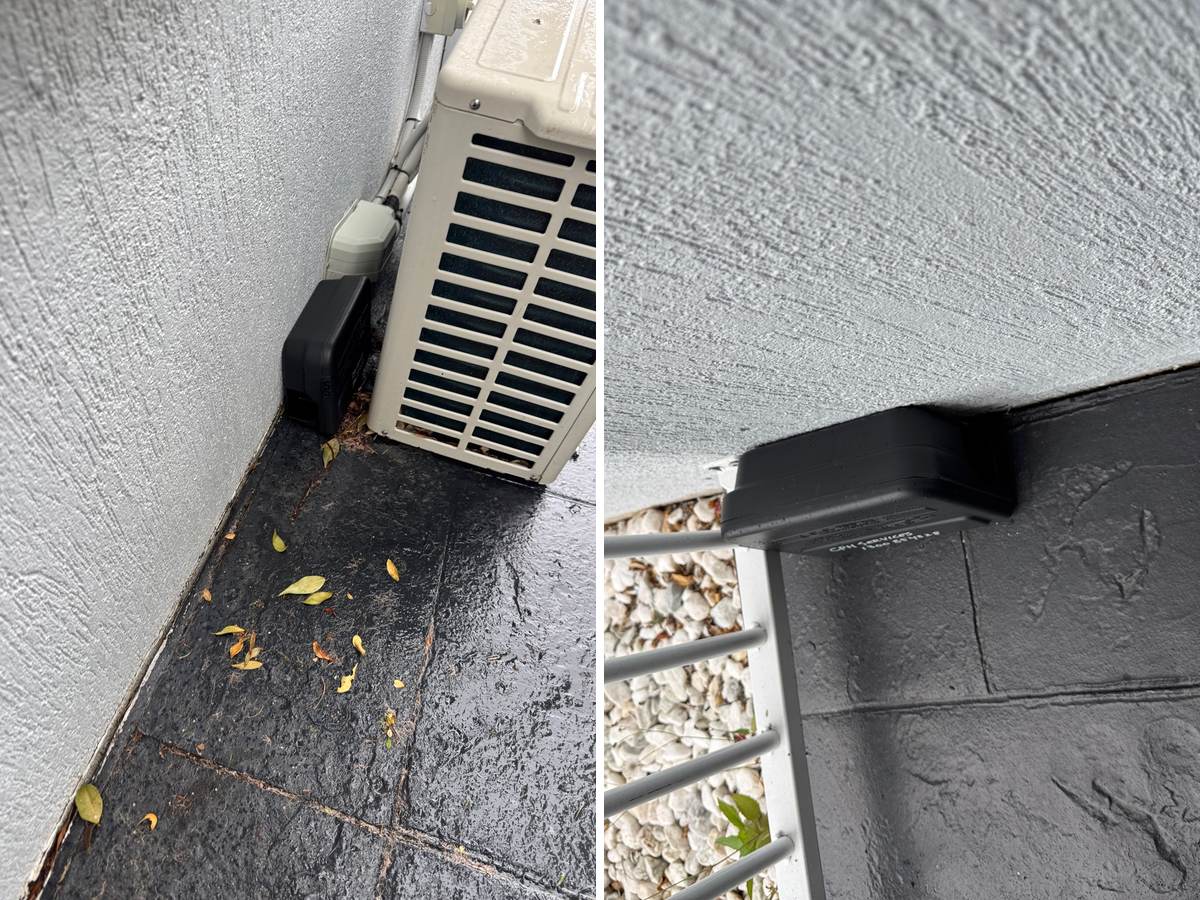
Rodent control Robina. Two of the stations from the initial baiting program: one tucked in beside the air conditioning unit, one set flat against the wall.
Rats need water as much as food, and a backyard pool is the easiest drink on the street. The trouble is the smooth sides. A rat that slips in often cannot climb back out, which is why the pool is where plenty of Gold Coast families see their first one.
One rat on its own is not proof of an infestation. Alongside the activity this family had already noticed, it was enough to look properly, and calling at the first clear sign keeps the job smaller.
How we identified roof rats
Roof rats are the climbers. They are slimmer than the heavier ground dwelling rats, with large ears, a pointed snout and a tail longer than the head and body together. Their droppings are narrow with pointed ends.
Behaviour gives them away as much as looks do. Roof rats travel up high, along fence tops, overhanging branches, cables and the gutter line, and they shelter in roof voids, thick palms and dense planting. The heavier rats tend to burrow and stay at ground level. That difference decides where the stations go.
The initial baiting program around the property
The photos show two of the stations. One is tucked in beside the air conditioning unit, the other sits flat against the wall. Both spots follow the same logic: rats run along edges and stay close to cover, so a station on their path gets found and one out in the open does not.
Every station is lockable and tamper resistant. It opens with a key, not by hand, and it is secured in place so it cannot be dragged off or knocked about. Outdoor stations sit close to the house, which is also one of the conditions under the updated rules.
It is an initial program: the first round, set from what the inspection showed, to be checked and adjusted rather than left to run.
Stations deal with the rats already moving around the property. Finding how they reach the roof is the other half of the job, and there is more on that in our post on how rodents get into Gold Coast homes.
Got questions? Straight answers below. Or skip ahead:
The family wanted to know what had gone down on their property, and they were right to ask. Under the updated rules it is something every customer should know. The bait used is named on the service record you receive, so it is in writing rather than something you have to remember from a chat in the driveway.
For the adults. The bait sits inside a locked station, held in place, never loose on the ground. Leave the stations where they are, do not open or move them, and call us if one is damaged or has shifted.
For the children. A child cannot open a station by hand, and there is nothing on the ground to pick up. It is still worth telling older kids that the black boxes are not toys and to leave them alone.
For the pets. The station keeps a dog or cat away from the bait itself. The risk that is harder to see is a pet catching or eating a rodent that has taken bait, because these baits stay in the rodent's body. Owls and other birds of prey face the same risk. If you find a dead rodent, do not pick it up with bare hands and do not leave it for the dog. Call us and we will remove it.
The return inspection
The return visit is already in the diary. The conditions on rodent baits were updated, and bait can no longer simply be left down indefinitely. A licensed technician has to come back within a set window, evaluate whether the treatment is working, record it, and take the bait away once the activity has stopped. That applies to every licensed pest controller in Australia, not just us.
On a roof rat job that inspection looks up as well as down. Each station gets opened and checked, and the fence tops, branches and roofline the rats were using get looked at again for fresh signs. If the activity has stopped, the bait comes out. If it has not, baiting carries on and the next check is set.
Warranty and cost
Rodent work is an add on to general pest control rather than part of the standard treatment, which covers cockroaches, ants and spiders. On rodents, warranties may apply depending on the circumstances at your particular property and on the infestation itself, assessed on an as needs basis rather than promised as a set number.
The estimate covers both the initial baiting and the return inspection, so the second visit is never a surprise. The minimum call-out fee is $145 plus GST. Our pest control page sets out how a rodent program is booked on top of a general treatment, and for this family the carpets are part of the same arrangement, covered on our carpet cleaning Robina page.
Found a rat in the pool, or seeing signs around the house? Call 1300 85 48 28 and we will tell you honestly what it looks like and what it needs.
Frequently asked questions
How can I tell if I have roof rats?
Roof rats are slimmer than ground dwelling rats, with large ears, a pointed snout and a tail longer than the head and body. They travel along fence tops, branches and the gutter line and shelter up high in roof voids and thick palms. Narrow droppings with pointed ends are another sign.
Why would a rat end up in my swimming pool?
Rats need water, and a pool is an easy drink. The smooth sides make it hard for a rat that slips in to climb back out. One in the pool is rarely a one off, so it is worth having the property checked.
Are rodent bait stations safe around children and pets?
The bait sits inside a lockable, tamper resistant station that opens with a key and is secured in place, so a child or pet cannot get to it. The risk that is harder to see is a pet catching or eating a rodent that has taken bait, so call us to remove any dead rodent rather than leaving it.
Will you tell me what bait is used on my property?
Yes. The bait used is named on the service record you receive. Under the updated rules on rodent baits, knowing what has gone down on your property is something every customer should have in writing.
Why does rodent control need a return inspection?
Because the conditions on rodent baits were updated. Bait cannot be left down indefinitely, so a licensed technician comes back within a set window to evaluate whether the treatment is working, record it, and remove the bait once activity stops. It applies to every licensed pest controller in Australia.
Does rodent control come with a warranty?
Rodent work is an add on rather than part of the standard cockroach, ant and spider treatment. A warranty may apply depending on the circumstances at your property and on the infestation itself, assessed on an as needs basis rather than set as a flat number.
Ready for an honest estimate?
Tell us about the job. Phil replies personally between jobs, usually within 2 to 4 hours. Urgent? Call 1300 85 48 28. No pressure, no lock-in, no call centre.