Carpet Cleaning Elanora: What a Pet Accident Actually Leaves Behind
The wrong first move on a pet accident does more damage than the accident did. Scrubbing spreads the mark and pushes it deeper into the fibre. A recent Elanora job shows what actually lifts a pet mark, and what only looks like it does.
✔ Family & pet safe treatments✔ Licensed & insured✔ IICRC accredited✔ Since 2011
What Gold Coast locals say on Google 5.0 stars from 396 Google reviews
"Phil is not only a great guy, but he genuinely knows how to solve any problem you throw at him, and we've certainly had a few over the years."
Melanie B., Google review
★★★★★
"Phil is hands-down the best pest control guy we've ever had. He shows up right on time, always friendly and professional, and took the time to actually explain what he was doing and why."
Tanya G., Google review
★★★★★
"Had an amazing experience. They were very quick and efficient, I couldn't have asked for anything more. Phil and his team did an amazing job and couldn't recommend more."
Jorja W., Google review
★★★★★
"Gave me honest and genuine advice and service at a great price."
Google review
★★★★★
"Extremely high standard of work, communication and customer service."
Google review
★★★★★
"Phil and Cooper did a fantastic job cleaning our carpet, rugs and furniture."
Google review
Short answer: most pet marks lift, some do not, and the difference is often decided in the first ten minutes by whoever finds it. Carpet cleaning in Elanora after a pet accident runs in two steps, an antibacterial enzyme treatment followed by truck mounted extraction, and neither of them is scrubbing. One thing we will not do is guarantee stain removal. No honest operator does.
Written by Phil, CPH Services Gold Coast. Carpet cleaning technician and licensed pest control technician, working Gold Coast properties since 2011. IICRC accredited. Three Best Rated Best Business, 2016 to 2026.
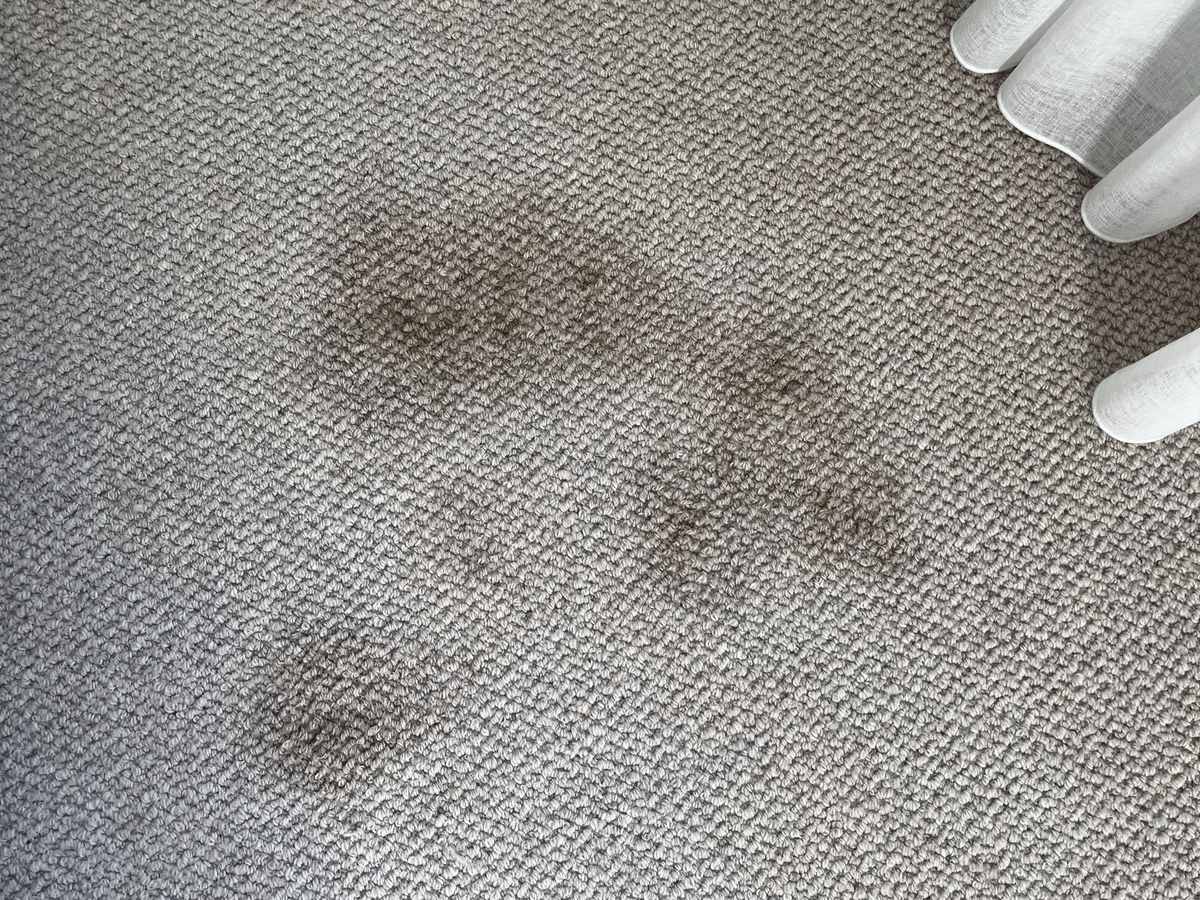
Marks near the curtains in an Elanora lounge room
The photo above is the before shot from a recent Elanora job. A handful of solid waste marks on a natural fibre carpet, over near the curtains. Nothing dramatic. No flooding, no smell you could pick up from the doorway.
That is most pet accidents, in truth. Not an emergency. Just the mark that will not shift, and the quiet doubt about whether it ever will.
Why scrubbing makes it worse
The instinct is to get down there with a cloth and work at it. It is the wrong move, and it is worth explaining why rather than just saying do not.
Scrubbing does two things. It spreads the contamination outwards, so a mark the size of a coin becomes a shadow the size of a dinner plate. And it drives what is left downwards, past the tips of the fibre where it could have been lifted, into the base of the pile and sometimes into the backing. A surface problem becomes a structural one.
Heat is the other common mistake. Hot water or steam on an acidic pet stain sets it rather than lifting it. That is why a pet job is not handled the same way as general Gold Coast carpet cleaning, even though it happens with the same truck and much of the same equipment.
Enzyme treatment first, extraction second
The fix runs in two parts and the order is not negotiable. An antibacterial enzyme treatment goes down first and is given time to work. Enzymes break down the organic matter itself, which is the actual source of both the mark and the smell. Heavier, more established soiling gets an antimicrobial enzyme treatment instead.
Then truck mounted extraction pulls the treatment, and everything it has broken down, back out of the fibre. That second step is the one that cannot be done at home, which is why a bottle from the supermarket often seems to work for a fortnight and then does not.
Nothing in this process involves covering the smell. Masking products buy you a few days, and then the problem is exactly where it was, usually on the first warm afternoon.
Got questions? Straight answers below. Or skip ahead:
This carpet was a natural fibre loop pile, which matters. Natural fibres hold moisture longer, respond differently to pH, and can distort if they are over-wet. The method stays the same. The product and the moisture control change.
It is the same reasoning behind treating a wool rug differently to a synthetic one. Matching the product to the fibre is most of the skill in this trade, and it is the part that separates a careful carpet cleaner from someone running one setting on everything.
What we can say, and what we cannot
We do not guarantee stain removal. What we can do is tell you what we expect from this fibre, this mark and this age of soiling, and say it before starting rather than offering it as an excuse afterwards.
On this job the marks lifted well. On a carpet where waste has sat for weeks and worked through to the underlay, the answer would have been different, and the customer would have heard that first.
What carpet cleaning Elanora costs after a pet accident
It moves with how much of the carpet is affected and how much treatment those areas need, not with a fixed per-room figure. Three marks in one room is a small job. Pet damage running through a whole living area is not.
The number that does not move is the minimum call-out fee, $145 plus GST, anywhere from Gold Coast to Tweed Heads. Tell us roughly how many areas are affected and how long ago it happened, and you will have an honest estimate up front.
Pet accident on the carpet in Elanora, Palm Beach or Currumbin? Call 1300 85 48 28. The sooner it is treated, the better the odds.
Frequently asked questions
Do you clean carpets in Elanora?
Yes. Elanora is part of the regular run, alongside Palm Beach, Currumbin and Burleigh Heads, and the whole Gold Coast to Tweed Heads area is covered.
Can a pet stain be removed completely?
Often, but not always, and we will not promise otherwise. It depends on how long it sat, what the fibre is, and whether anything reached the backing or the underlay. Where a mark is likely to be permanent, we say so before we start rather than afterwards.
What should I do straight after a pet accident?
Lift the solids carefully, then blot straight down with a clean white cloth. Do not scrub, and do not pour hot water over it. Cool water and patience do far less damage than force. Then call someone before it dries in.
How do you deal with the smell, not just the mark?
With an antibacterial enzyme treatment, which breaks down the organic matter causing the smell rather than covering it over. Heavier, more established soiling gets an antimicrobial enzyme treatment instead. Masking a smell only hides it until the carpet warms up again.
Is enzyme treatment safe around pets and children?
Yes, applied as directed. It is a standard part of pet stain work and the products we use are family and pet safe. We will tell you how long to keep the area clear while the carpet dries.
Can a natural fibre carpet be steam cleaned?
Yes, with a product suited to that fibre and the moisture kept under control. Natural fibres take longer to dry and behave differently to a synthetic loop, so the products and the drying change even though the equipment is the same.
What does pet stain carpet cleaning in Elanora cost?
It follows the number of affected areas and how much treatment they need. A couple of marks in one room is not the same job as pet damage through a whole living area. The minimum call-out fee is $145 plus GST, and you get an estimate before we start.
Ready for an honest estimate?
Tell us about the job. Phil replies personally between jobs, usually within 2 to 4 hours. Urgent? Call 1300 85 48 28. No pressure, no lock-in, no call centre.